
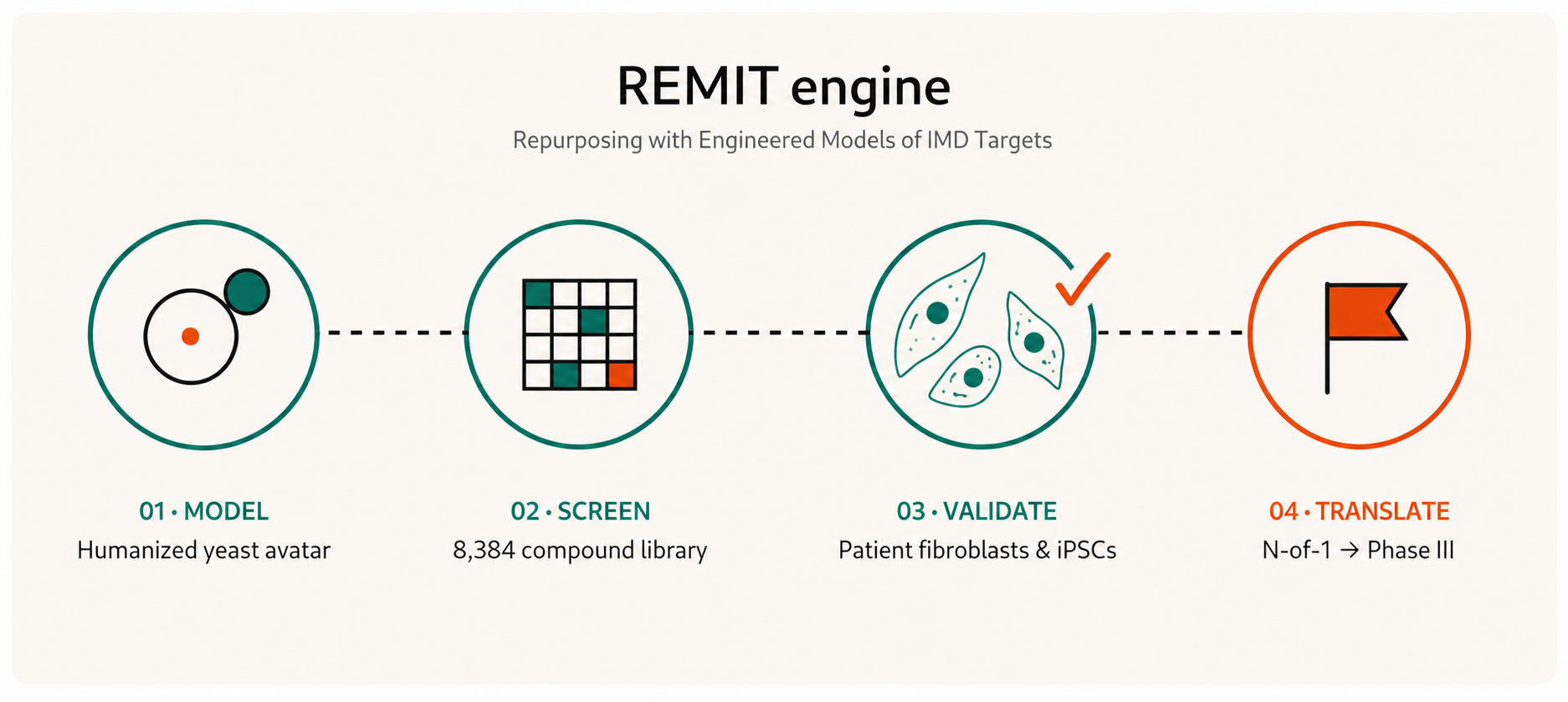
A vertically integrated engine for inherited metabolic diseases: build a humanized yeast avatar, screen a standardized library of ~8,400 compounds, validate hits in patient cells, and translate into a registrational trial alongside the family and foundation that brought us the program.



Yeast has ~30% ortholog overlap with the human Mendelian disease genome, the fastest growth curve of any eukaryote, and — critically — tolerates gene-dose mutations that are lethal in mammalian cells. A campaign that takes a mouse facility 18 months takes us 8 weeks.
Mitochondrial disorders affect ~1 in 4,300 children and have essentially no labeled therapies. The Perlara mitochondrial portfolio covers Complexes I–V using Yarrowia lipolytica (which uniquely retains a functional Complex I) and S. cerevisiae.

Yeast screen complete; 6 of 12 top rescuers reproduced in patient fibroblasts. Currently in IND-enabling planning with Cure Mito Foundation.
Targeted chemical perturbation in Y. lipolytica to validate key Complex I components. Platform advancing toward functional mapping of common CI deficiencies (SBIR Aim 1).
MT-ATP6 and Complex V deficiencies
Subunit-level profiling underway to model ATP synthase dysfunction. Family partnerships via United Mitochondrial Disease Foundation.
Congenital disorders of glycosylation (CDGs) are the prototypical Perlara program: well-defined enzymes, dramatic patient phenotypes, and a tractable yeast model thanks to ~70% pathway conservation.

The flagship Perlara program. 40-patient Phase III at Mayo Clinic Minnesota; an aldose-reductase inhibitor approved in Japan, repurposed.
α-1,2 mannosyltransferase deficiency. TargetMol screen completed and yeast hits were validated in a fly model of ALG11-CDG.
Multi-family collectives for these GPI-anchor disorders. PIGW screen complete; one parent-driven N-of-1 study ongoing.
Dolichol biosynthesis defect. Yeast model active and TargetMol screen complete. Multi-patient 1-to-N observational study ongoing.
Mitochondrial disorders affect ~1 in 4,300 children and have essentially no labeled therapies. The Perlara mitochondrial portfolio covers Complexes I–V using Yarrowia lipolytica (which uniquely retains a functional Complex I) and S. cerevisiae.
NIH NCATS Direct-to-Phase-II award funds the ETC Complex I–V buildout in Yarrowia lipolytica and S. cerevisiae.
Most programs are co-funded by the disease-specific foundation that brought the patient. Examples: Cure Mito Foundation, United Mitochondrial Disease Foundation, and CDG CARE.


